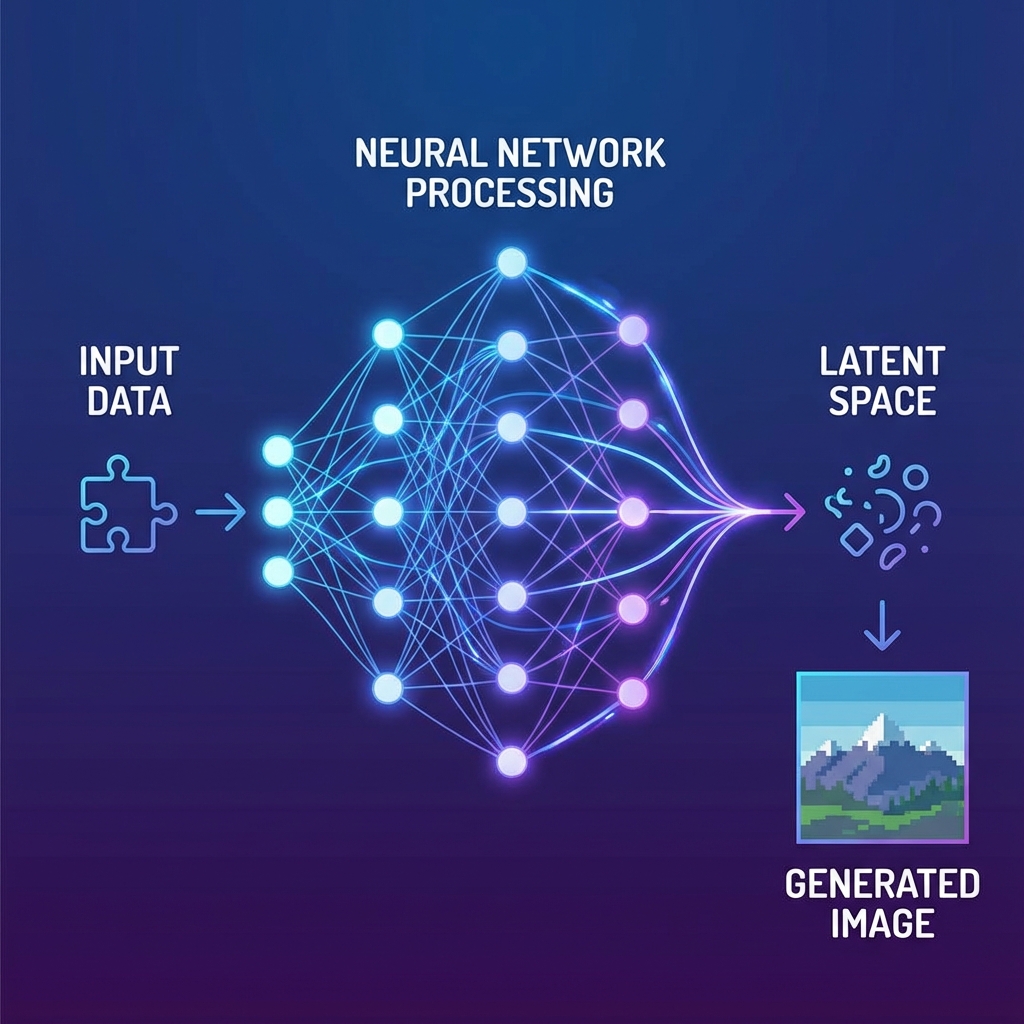
Ever wondered how a simple phrase like "a panda surfing on a rainbow" can be transformed into a vibrant, detailed image? The technology behind it, known as text-to-image generation, is a fascinating blend of artificial intelligence, machine learning, and vast datasets of images and text.
Understanding the Core Concepts: Diffusion Models
At the heart of AI image generators like Magnuto are complex neural networks called "diffusion models." Think of these models as digital artists that have studied millions of images and their corresponding descriptions. They learn the intricate relationships between words and visual elements, allowing them to create entirely new images from scratch.
The process starts with a field of random noise—like a blank canvas filled with television static. The AI model then begins a process of "denoising," slowly and iteratively shaping the randomness into a coherent image that matches the text prompt. It's like a sculptor chipping away at a block of marble, but instead of a chisel, the AI uses your words as its guide. With each step, the image becomes clearer and more defined, until the final masterpiece emerges.
The Role of Language Models
To understand your prompt, the AI uses a sophisticated language model. This model, similar to the technology behind chatbots, breaks down your sentence, identifies the key subjects, actions, and styles, and translates them into a mathematical representation that the diffusion model can understand. This is why the phrasing of a prompt is so crucial—the more descriptive and clear the text, the better the AI can interpret your intent and bring your vision to life.
Training the AI: A Digital Education
The magic doesn't happen overnight. These AI models are trained on massive datasets containing billions of image-text pairs scraped from the internet. During this intensive training process, the model learns to associate words like "cat" with the visual features of a cat, "blue" with the color blue, and "Impressionist painting" with the stylistic elements of that art movement, such as visible brushstrokes and an emphasis on light.
This extensive training is what allows the AI to generate such a diverse and creative range of images, from photorealistic portraits to surreal landscapes. It's a continuous learning process, and as the models are trained on more data, their ability to generate high-quality, accurate images will only improve.
The next time you use Magnuto to generate an image, take a moment to appreciate the complex and elegant process happening behind the scenes. It's a testament to how far AI has come and a glimpse into the future of creativity that is accessible to everyone.